New Release · Nonfiction
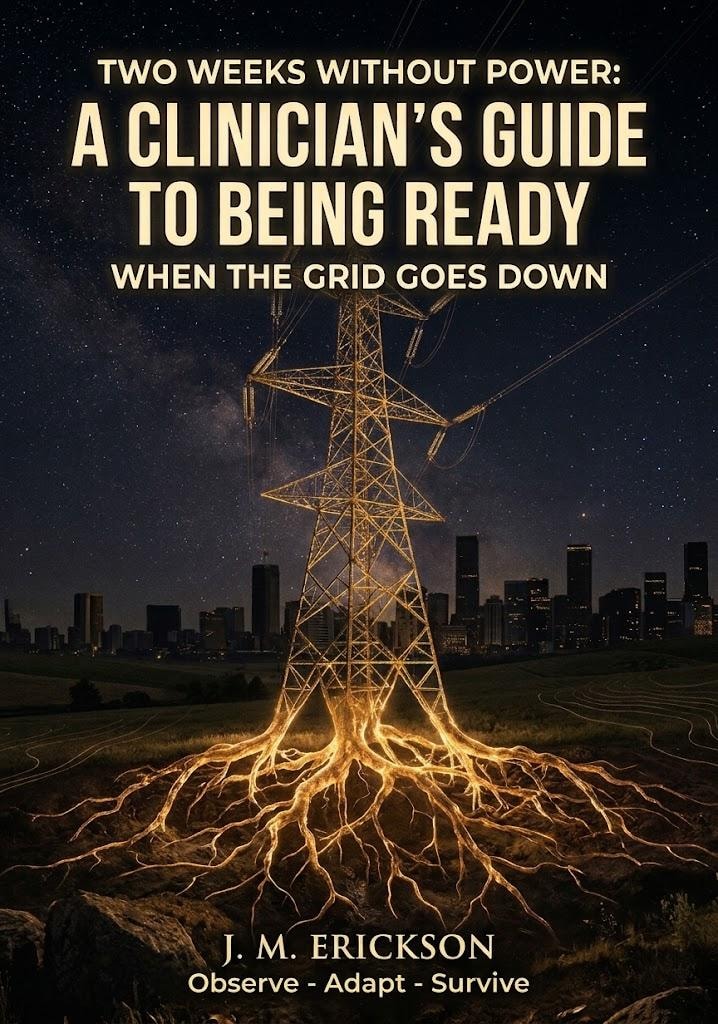
Two Weeks Without Power
A Clinician's Guide to Being Ready When the Grid Goes Down
Two Weeks Without Power is built on FEMA's own fourteen-day standard, not an author's worst-case scenario. It organizes preparation around four requirements rather than a gear list: water, food, and sanitation for fourteen days; medication with a plan for day fifteen; one room heated or cooled to survive; and four to six neighbors who would answer the door at two in the morning.
Written by a licensed clinical social worker with forty years of practice, it covers what most preparedness books skip — executive function under stress, withdrawal as a medical emergency, and how to assess a person's behavior without profiling them. Twelve chapters, twenty-one tables, eight photocopiable worksheets, and Texas City, Texas and Uxbridge, Massachusetts compared side by side.
Four Requirements. Not a Gear List.
Everything in the book is either a way of meeting these four requirements or a way of extending them past fourteen days. There is no third job, and the reader always knows which one they are doing.
Water, Food & Sanitation
Fourteen days without municipal supply — calculated by household size, not by a generic gear list.
Medication & Medical Equipment
Fourteen days of every prescription in the house, with a written plan for day fifteen.
One Survivable Room
Heated or cooled to a temperature that will not kill you, with a way to cook inside it.
Four to Six Neighbors
People who would answer the door at 2 a.m. — the social infrastructure that determines whether the other three hold.
What Makes It Different
Three things no other preparedness book covers
A clinician wrote it — and that changes the content, not just the tone.
Other preparedness books tell you what to store. This one tells you what actually kills people first, in what order — including the clinical facts no gear list covers. Alcohol and benzodiazepine withdrawal can be fatal without medical management, and in a blackout there is none. Fear shuts down the frontal cortex, which is why untrained people make their worst decisions exactly when decisions matter most. And assessment is not profiling: the book gives households a way to judge conduct rather than categorize people, which is what keeps a group intact.
The standard is federal and measurable, so the reader always knows where they stand.
Two weeks is FEMA's own shelter-in-place recommendation — the length of outage most households will actually face, and the point at which the refrigerator, the pipes, and the prescriptions all stop working at once. Everything in the book either meets those four requirements or extends them past fourteen days. There is no third job, and no vague advice about being "better prepared."
It is geographically specific where every other book is generic.
Texas City, Texas and Uxbridge, Massachusetts run through the same fourteen-day framework at three days, ten days, thirty, and a year. A Gulf Coast reader faces lethal heat, humidity that ruins dressings, and petrochemical risk. A New England reader faces lethal cold, frozen pipes, and the cardiac events that follow a snow shovel. The advice is built for each place rather than hedged to fit both.
What's Inside
From water math to neighborhood networks — each chapter addresses one concrete problem.
Calculated by household size, climate zone, and medical need — not generic averages.
Barrier audits, self-awareness screens, and role-assignment lists for every age group.
One Framework. Two Real Towns.
The same fourteen-day standard is applied to Texas City, Texas and Uxbridge, Massachusetts — at three days, ten days, thirty, and a year. A Gulf Coast reader and a New England reader get one framework applied to genuinely different hazards: lethal heat and petrochemical risk on one side, lethal cold and frozen pipes on the other.
Why a Clinician Wrote This Book
J. M. Erickson is a licensed independent clinical social worker with forty years of practice in settings that did not allow for optimism — locked juvenile units, inpatient admission wards, and residential programs for emotionally disturbed children. He is also a gun owner, a martial artist, and a radio operator who learned those skills late and on purpose. This book is the intersection of all of it.
Clinical Practice
Licensed Independent Clinical Social Worker (LICSW) · 40+ years in locked juvenile units, inpatient admission wards, and residential programs for emotionally disturbed children
Academic Training
B.A. Boston College (Psychology & Sociology) · M.S.W. Simmons University · Clinical training at the M.S.W. level, Children's Hospital Department of Psychiatry & Judge Baker Guidance Center, Boston (1985–1986)
Postgraduate Certificates — Boston University
Psychological Trauma: Clinical Assessment and Treatment Certificate Program (2001–2003) · Human Services Agency Management Certificate Program (1999–2001) — both awarded by the BU School of Social Work Professional Education Program
Continuing Clinical Education
Harvard Medical School — Emerging Strategies in Assessment & Treatment of Depression and Anxiety · PESI DBT Certificate Course · NetCE coursework in anxiety disorders, mass violence, bioterrorism, and trauma-focused care
Firearms & Tactical Training
Massachusetts Basic Firearms Safety Certificate · SIG Sauer Academy — multiple handgun and modern sporting rifle courses · SAFTD F.A.S.T. Handgun (Second Amendment Foundation Training Division) · Visiting Lecturer, Cambridge Police Academy (1992)
Martial Arts & Communications
Shodan (1st-degree black belt), American Kenpo — recognized as Sensei, Nick Cerio's International Martial Arts Association (1994) · Licensed amateur radio operator — emergency communications background
"This manual is what I know, compressed. It is written for my own two children and for everyone raised the way they were — inside an artificial biosphere of electricity, plumbing, refrigeration, and instant information, with no experience of what happens when those things stop."
— J. M. Erickson, from the author's note
Publishing January 10, 2027
Available through Amazon, Barnes & Noble, and Smashwords. Pre-order links will be added as they go live.